Breathe Like You Mean It: How Showing Up Every Day Changed Everything
You know that constant hum of stress, the kind that sticks around like an uninvited guest? I did too—until I started paying attention to something I’d ignored my whole life: my breath. Turns out, simply breathing with intention, daily, isn’t just calming—it reshapes your nervous system. This isn’t about quick fixes, but the quiet power of consistency. Let’s talk about how showing up for yourself, one breath at a time, builds something real.
The Hidden Crisis of Shallow Breathing
Modern life has quietly rewired the way we breathe, often without us even noticing. The average adult spends hours each day hunched over screens, shoulders tense, chest tight—postures that encourage shallow, upper-chest breathing rather than the deep, rhythmic expansion the body was designed for. This shift may seem minor, but its effects are far-reaching. When breathing becomes restricted to the upper lungs, the body interprets this as a sign of danger, triggering a low-level, persistent stress response. The nervous system remains in a state of alertness, releasing cortisol and adrenaline even when no real threat exists. Over time, this chronic activation wears down both mental and physical resilience.
The natural, healthy pattern of breathing engages the diaphragm—a dome-shaped muscle beneath the lungs that contracts and flattens during inhalation, drawing air deep into the lower lungs. This is known as diaphragmatic or abdominal breathing. But in today’s fast-paced environment, many people default to clavicular breathing, where the shoulders and collarbones lift with each breath. This method is inefficient, delivering less oxygen and failing to activate the body’s calming mechanisms. It is commonly seen during moments of anxiety, but for many, it has become the default, even at rest. The result is a body that never fully switches off, stuck in a loop of subtle tension and fatigue.
What makes this pattern so insidious is that it operates beneath conscious awareness. A person may feel generally tired, irritable, or unable to focus, never realizing that their breath is contributing to the problem. Children naturally breathe from the belly, but as they grow and adopt adult postures and stress patterns, this instinctive rhythm is often lost. The transition is gradual, influenced by prolonged sitting, emotional suppression, and the constant stimulation of digital devices. The breath becomes quicker, higher, and more erratic—a reflection of a mind that is always busy, always reacting.
Scientific research supports the link between breathing patterns and nervous system regulation. Studies have shown that shallow breathing correlates with increased activity in the sympathetic nervous system—the branch responsible for the “fight or flight” response. In contrast, slow, deep breathing activates the parasympathetic nervous system, which governs rest, digestion, and recovery. The breath, therefore, acts as a direct line to the autonomic nervous system, offering a rare form of voluntary control over involuntary processes. When we breathe poorly, we signal stress; when we breathe well, we signal safety. The good news is that this connection can be retrained, not through force, but through daily, mindful repetition.
Why “Just Breathe” Isn’t Enough
How many times have you heard someone say, “Just breathe,” in moments of frustration or anxiety? While well-intentioned, this advice often falls short because it lacks context and consistency. Taking a few deep breaths during a crisis may offer temporary relief, but it does not address the underlying patterns that keep the nervous system on edge. The real transformation comes not from reactive breathing, but from proactive, daily practice. Like brushing your teeth, the benefit lies not in doing it once, but in doing it every day. Without routine, the effects are fleeting; with consistency, they become foundational.
The human brain is shaped by repetition. Neural pathways strengthen with use, a concept known as neuroplasticity. When stress becomes habitual, the brain builds strong connections that make anxiety and reactivity the default response. But those same mechanisms can be used to build new, healthier patterns. Intentional breathing, practiced regularly, begins to rewire the brain’s response to stress. Over time, the nervous system learns to return to balance more quickly, not because of a single deep breath, but because of hundreds of small, repeated acts of regulation. This is not about intensity—it’s about showing up, day after day, even when you don’t feel like it.
Consider the analogy of physical fitness. No one expects to become strong by lifting weights once a month. Strength builds through regular exercise, even in small doses. The same principle applies to breath training. A five-minute practice every morning may seem insignificant, but over weeks and months, it creates measurable changes in heart rate variability, emotional regulation, and mental clarity. The key is not to wait until you’re overwhelmed to breathe, but to build resilience before stress takes hold. This shift—from crisis management to daily maintenance—is what turns breathing from a quick fix into a lifelong tool.
Another reason “just breathe” often fails is that it lacks structure. Without guidance, people may take rapid, forceful breaths that can actually increase anxiety. Effective breathwork is gentle, rhythmic, and sustainable. It’s not about pushing the body to extremes, but about restoring a natural rhythm. When practiced with intention and regularity, it becomes a form of self-care that requires no special equipment, no expensive classes, and no major time commitment. It is, quite simply, one of the most accessible and powerful tools for well-being—available to anyone, anywhere, at any time.
What Is Diaphragmatic Breathing—And Why It Works
Diaphragmatic breathing, also known as belly breathing, is the body’s most efficient and calming way to breathe. It involves the full engagement of the diaphragm, allowing the lungs to expand fully and draw in maximum oxygen. When you inhale deeply through the nose, the diaphragm contracts downward, creating space in the chest cavity. This causes the belly to rise gently, while the chest remains relatively still. On the exhale, the diaphragm relaxes upward, gently pushing air out of the lungs. This process is not only more effective for oxygen exchange but also sends a clear signal to the brain that the body is safe.
To check if you’re breathing this way, place one hand on your chest and the other on your belly. As you inhale, notice which hand rises more. If the hand on your chest moves significantly while the one on your belly stays still, you’re likely breathing shallowly. If the belly rises first and fullest, you’re engaging the diaphragm. Many people are surprised to discover that they’ve been chest breathing for years without realizing it. The good news is that diaphragmatic breathing is a skill that can be relearned at any age. It doesn’t require special training—just awareness and practice.
The physiological benefits of this breathing style are well-documented. Deep, slow breaths stimulate the vagus nerve, a major component of the parasympathetic nervous system. This stimulation helps lower heart rate, reduce blood pressure, and calm the mind. It also improves oxygen delivery to tissues, supports digestion, and enhances mental focus. Unlike rapid, shallow breaths that keep the body in a state of alert, diaphragmatic breathing promotes relaxation and recovery. It is the body’s natural way of restoring balance after stress.
Some may view belly breathing as a trend popularized by mindfulness or yoga, but it is, in fact, the way humans are designed to breathe. Infants, animals, and people at rest all breathe this way instinctively. It is only under stress or poor posture that the pattern shifts. Reclaiming this natural rhythm is not about adopting a new habit, but about returning to an old one—one that has been buried under years of habit and habituation. By practicing diaphragmatic breathing daily, you are not forcing your body to do something unnatural; you are helping it remember what it already knows.
Building Your 5-Minute Daily Foundation
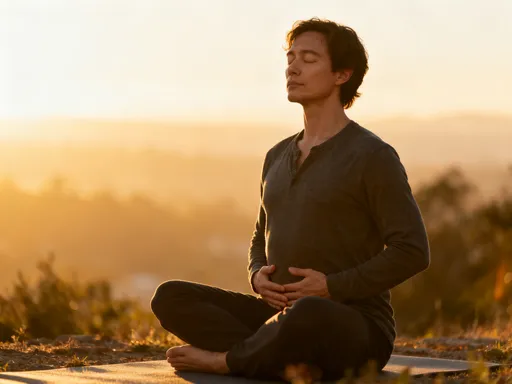
Starting a breath practice doesn’t require hours of meditation or complex techniques. The most effective approach is simple, sustainable, and integrated into daily life. A five-minute routine, practiced at the same time each day, is enough to create lasting change. Choose a quiet moment—perhaps first thing in the morning or just before bed—when distractions are minimal. Sit in a comfortable chair with your feet flat on the floor, or lie down if that feels better. Keep your spine reasonably straight but not rigid, allowing your body to be alert yet relaxed.
Place one hand on your belly and the other on your chest. Close your eyes or soften your gaze. Begin by inhaling slowly through your nose for a count of four, feeling your belly rise beneath your hand. Pause briefly at the top of the breath, then exhale gently through your mouth for a count of six. The longer exhale is key—it enhances the calming effect by further stimulating the vagus nerve. Repeat this cycle for five minutes, focusing your attention on the rise and fall of your belly. If your mind wanders, gently bring it back to the breath without judgment.
The goal is not perfection, but presence. Some days your breath may feel smooth and steady; other days it may be uneven or distracted. That’s okay. What matters is showing up. You don’t need special clothing, a quiet house, or a perfect mood. Even five minutes in the midst of a busy day can reset your nervous system. Over time, this small investment yields significant returns: greater calm, improved focus, and a stronger sense of control over your emotional state.
To support consistency, consider using ambient cues. Light a candle, play soft instrumental music, or use the same corner of your home each time. These small rituals signal to your brain that it’s time to pause and breathe. You might also pair the practice with an existing habit, such as after brushing your teeth or before your first cup of coffee. The more seamlessly it fits into your routine, the more likely you are to stick with it. Remember, this is not about adding one more task to your list—it’s about creating space within your day to reconnect with yourself.
Making It Stick: Habit Stacking and Gentle Accountability
One of the biggest challenges in building any new habit is consistency. Life gets busy, moods shift, and motivation fades. That’s why relying on willpower alone is rarely enough. A more effective strategy is habit stacking—linking your new practice to an existing routine. For example, you might decide to breathe for five minutes immediately after washing your face in the morning or right before turning off the lights at night. Because these actions are already automatic, they serve as reliable triggers for your breath practice. Over time, the sequence becomes ingrained: wake up, brush teeth, breathe. Or, finish dinner, clear the table, breathe. The existing habit acts as an anchor, making the new one easier to remember and perform.
Gentle accountability also plays a role. You don’t need to report to anyone or post on social media. Instead, try keeping a simple journal. Each day, after your practice, jot down one brief observation: how you felt before and after, whether your mind was restless, or if you noticed any physical changes. Over time, this record becomes a source of encouragement. You may begin to see patterns—less anxiety on days you breathe, better sleep, or a quicker recovery from frustration. These small shifts, when noticed, reinforce the value of the practice and make it more meaningful.
Equally important is self-compassion. There will be days when you forget, when you’re too tired, or when life feels too overwhelming to pause. Missing a day does not mean failure. Progress is not linear. The goal is not to be perfect, but to return—again and again—to the practice. Each time you come back, you strengthen your commitment. Think of it like watering a plant: it doesn’t grow from one deep watering, but from regular, consistent care. Your breath practice is the same. It thrives not on intensity, but on gentle, repeated attention.
Another helpful approach is to adjust expectations. This is not about achieving a blissful state or eliminating all stress. It’s about building resilience. Some days, the only win is sitting down for five minutes, even if your mind races the whole time. That still counts. The act of showing up is the practice. Over time, those moments accumulate, creating a foundation of calm that supports you through life’s inevitable challenges. You are not trying to change everything at once—you are building a small, steady anchor in the middle of the storm.
When to Expect Changes—And What They Feel Like
Change does not happen overnight, but it does happen. With daily practice, most people begin to notice subtle shifts within two to three weeks. These early signs are often internal and easy to overlook: a moment of pause before reacting to a stressful comment, a slightly slower heart rate upon waking, or the ability to fall asleep more easily. You might find that you catch yourself holding your breath during traffic or while reading emails—and then remember to release it. These small moments of awareness are the first indicators that your nervous system is beginning to recalibrate.
Emotional resilience tends to improve gradually. You may still feel frustration or sadness, but the intensity may be less, and the recovery time shorter. Where once a minor setback could derail your mood for hours, you might now find yourself able to reset more quickly. This is not because the external circumstances have changed, but because your internal response has shifted. The breath practice has created a buffer between stimulus and reaction—a space where choice becomes possible. In that space, you are no longer at the mercy of your emotions; you are learning to regulate them.
Physical changes also emerge over time. Many people report deeper sleep, fewer tension headaches, and improved digestion. These benefits are linked to the activation of the parasympathetic nervous system, which supports rest and recovery. As the body spends less time in survival mode, it can redirect energy toward healing and maintenance. Some notice that their shoulders feel less tight, their jaw unclenches more easily, or their breathing feels more natural throughout the day. These are signs that the practice is integrating beyond the five minutes—it is beginning to reshape your default state.
The timeline varies from person to person, but consistency is the common factor among those who see results. It’s not about how deeply you breathe during the practice, but how regularly you return to it. The cumulative effect of daily attention creates a new baseline of calm. You may not feel dramatically different every day, but looking back after a month or two, the contrast can be striking. What once felt like constant background stress now feels manageable. The breath has not erased life’s challenges, but it has given you a steadier way to meet them.
Beyond the Basics: Deepening Your Practice Over Time
Once the five-minute practice becomes a natural part of your day, you can gently expand it. You might extend the duration to ten minutes, or experiment with a longer exhale—inhaling for four counts and exhaling for eight. This extended exhale further enhances the calming effect, making it especially useful during moments of mild stress. You can also try practicing in different positions: seated, lying down, or even standing. The goal is not to complicate the practice, but to deepen your familiarity with your breath in various contexts.
Another progression is to bring mindful breathing into daily activities. Instead of reserving it for a dedicated session, you might take three conscious breaths before answering a phone call, while waiting for the kettle to boil, or during a work break. These micro-moments of awareness help integrate the practice into real life. Over time, you may find that your breath becomes a subtle companion—a quiet presence that helps you stay grounded even in motion.
Optional tools can support your journey, but they are not required. Guided audio recordings, available through reputable wellness platforms, can provide structure and gentle direction. Breath-tracking apps may help some users stay consistent, though they should not become a source of pressure. The focus should remain on the experience, not performance. Technology can be helpful, but the heart of the practice is simplicity: just you, your breath, and a few quiet minutes.
Ultimately, the most important progression is not in technique, but in relationship. As you continue to show up for your breath, you are also showing up for yourself. You are sending a quiet message that your well-being matters. This practice is not about achieving mastery or reaching a final destination. It is about cultivating a lifelong connection with a resource that is always available—your own breath. No matter where you are, no matter what you’re facing, you can always return to this simple act of presence. And in that return, you find not just calm, but a deeper sense of stability, strength, and self-trust.